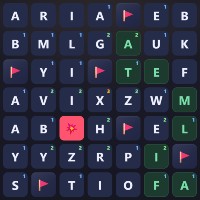
Begin by looking for certainty, not excitement. A numbered cell becomes useful when you can compare its number with the cells already opened or flagged around it. If a cell shows one and exactly one neighbouring closed cell remains possible, that cell must contain the mine. If a cell shows two and two neighbouring cells are already flagged, the other adjacent cells are safe. These small deductions are the foundation of a stable board.
Do not place a flag simply because a cell feels dangerous. A wrong flag can block your own reasoning. It may also hide a letter position that becomes important later. Mark mines when the number pattern supports the decision, and leave uncertain cells closed until another part of the board gives you more information.
Open broad safe areas early when the clues allow it. A larger revealed area does three things at once: it reduces the unknown minefield, exposes more numbers, and gives you more letters to remember. The word stage becomes much easier when you have already noticed useful fragments during the mine stage.
As letters appear, read them casually without abandoning the mine logic. You do not need to solve the words immediately. Just notice uncommon letters, repeated endings, and possible starting pairs. If you see T, H, and E close together, remember the area. If several vowels appear around one safe region, that part of the board may support more than one target path.
When the word hunt begins, start with the rarest-looking combination rather than the most obvious short word. Common letters can form many false paths. A less common letter often narrows the possibilities and helps you find one target quickly. After a word is found, use its position as a map reference for the remaining search.
Trace slowly enough to keep the path clean. A word can fail because the letters are wrong, but it can also fail because the path jumps over a cell or includes an extra letter. On a dense board, it is often better to lift your finger or release the mouse and try again than to force a path that has already gone off course.
Save skills for moments where they remove real uncertainty. An extra life is most valuable before a risky mine decision. A flag skill can help when the board has narrowed a danger area but not fully resolved it. Extra-letter, highlight, and extra-time skills become more useful during the word stage. Spending a skill only because it is available usually gives less value than waiting for the exact problem it was built to solve.