Minesweeper meets a word hunt

Word Minesweeper

Open safe cells, mark the mines, collect the letters, and then use the cleared board to find hidden words. It starts like Minesweeper and finishes like a word puzzle.

Number cluesHidden lettersWord pathsEasy, medium, hardTimed or free playDesktop and mobile
Word Minesweeper board
Choose a board

Play Word Minesweeper online

Pick a difficulty, choose the target word length, and decide whether you want a timed round or a calm free-play board. The selected letter length changes the words and rewards; the difficulty changes the board size, mine count, and number of target words.

A gentle start

Easy Word Minesweeper

Board 7 × 7 7 mines 3 target words

A compact board with enough room to learn the number clues without losing sight of the letters. The safe area opens quickly, so the word hunt arrives before the round feels heavy.

Best for a first game, a short break, or testing a new word length.

The balanced board

Medium Word Minesweeper

Board 8 × 8 11 mines 4 target words

More cells create wider clue patterns and more possible word paths. You have to switch between careful mine logic and active letter scanning instead of relying on one style of play.

Best for regular play when you want both parts of the game to matter equally.

A full puzzle session

Hard Word Minesweeper

Board 9 × 9 16 mines 5 target words

A larger minefield leaves more uncertainty and a denser field of letters. Every safe opening can change several deductions, while the final word hunt asks you to remember more of the board.

Best for experienced players who enjoy slower decisions and a longer finish.

Play timed: Timed mode continues into a three-minute word hunt after the mines are cleared and keeps the full reward setup.
Play free: Free mode removes the word timer and is made for practice, exploration, and relaxed play. Rewards are disabled in free mode.

A word game built inside a minefield

Word Minesweeper begins with a familiar kind of tension. You see a closed grid, you know that mines are hidden underneath it, and every safe cell gives you a number that says something about the surrounding area. The difference is that a safe cell also reveals a letter. By the time the dangerous part of the board is under control, the grid has turned into a second puzzle: a field of letters with hidden words running through neighboring cells.

That change gives the round a natural story. At first, you are trying not to make a mistake. You read the numbers, compare nearby cells, and decide where a mine must be. Later, you stop looking only at danger and begin looking for language. A row of ordinary letters may suddenly form the start of a word. A diagonal connection may complete it. A cell that seemed useful only as a clue can become the final letter you need.

The game is not a normal Minesweeper board with words pasted on top. Both parts affect how you play. Revealing a safe area gives you more letters, but it also changes which routes are available for a word. A flag protects you from a careless click, but too many uncertain flags can make the board harder to read. Finding the mines quickly gives you more time to study the letters in timed mode, while a cautious opening can make the later word hunt much clearer.

This makes the game easy to understand but difficult to play on autopilot. You cannot solve everything by clicking randomly because the mines punish careless guesses. You cannot solve everything by staring at the numbers because the round eventually asks you to recognize words. The most satisfying games are the ones where the two ways of thinking begin to support each other.

Word Minesweeper is designed for browser play. There is no download required, the board fits comfortably on desktop and mobile, and a new round can begin in a few seconds. Choose a board above, select the word length you want, and play either with a timer or without one.

How to play Word Minesweeper

The first stage works around classic Minesweeper logic. Open a cell to reveal what is underneath it. A mine costs a life. A safe cell shows a letter and, when mines are nearby, a number. That number tells you how many mines touch the cell around its edges or corners. A zero area can open a wider safe region, while a high number means the surrounding space deserves more attention.

Use flags on cells that you believe contain mines. A flag is not only a visual reminder. It helps you separate confirmed danger from cells that are still uncertain. On desktop, the board supports the usual mouse actions. On touch devices, the controls are adjusted so that the same decisions remain comfortable without needing a physical mouse.

You have three lives. Hitting one mine does not immediately end the entire round, but it makes the rest of the board less forgiving. This is important because the game should reward deduction without turning one imperfect tap into an instant restart. You can recover from a mistake, yet repeated guessing still has a real cost.

Once the mine objective is complete, the word stage takes over. The revealed letters remain on the board. Select connected cells to build a word. A path can move through neighboring cells, and the exact route matters because the same letter may appear in several places. When the selected path forms one of the hidden target words, the word is recorded and its cells become part of your progress.

In timed mode, the word hunt has a separate countdown. The mine stage is therefore not only about survival; it is also preparation. A clean board gives you more time and a better view when the letters become the main focus. In free mode, the word timer is removed, so you can inspect every route at your own pace.

The round ends when all required words are found, when all lives are lost, or when the word timer expires in timed play. A completed board can award XP, mood, and coins to a signed-in player. The reward level depends on the selected word length and difficulty. Free mode is intentionally reward-free, which keeps it useful as a practice space rather than a risk-free way to farm progress.

Easy, medium, and hard are different boards, not just faster timers

Easy uses a 7 by 7 board with seven mines and three target words. It gives the numbers enough space to create real deductions, but the board stays small enough to scan as a whole. When you reveal a new letter, you can usually remember where it sits without repeatedly searching the grid. This is the best place to learn how mine clues and word paths interact.

Medium expands the board to 8 by 8, places eleven mines, and asks for four target words. The extra cells create more partial clues. You may know that one of two cells contains a mine without knowing which one yet. At the same time, the larger letter field offers more tempting word fragments. Medium mode is where patience begins to matter.

Hard uses a 9 by 9 board with sixteen mines and five target words. The board is not difficult because every click is a trap. It is difficult because several small uncertainties can overlap. A decision made in one corner may become clear only after you open cells somewhere else. When the word stage begins, the larger field also gives you more routes to compare.

The difficulties use the same basic rules, so moving up does not require learning a new game. What changes is the amount of information you must hold at once. Easy lets you focus on one clue cluster. Medium often asks you to compare two or three. Hard rewards players who can leave an uncertain area alone, make progress elsewhere, and return when the board provides stronger evidence.

There is no shame in staying with the easy board. A compact round can be more enjoyable than a large one, especially when you are experimenting with eight, nine, ten, or eleven-letter targets. Difficulty and word length are separate choices, which means you can create a short hard game or a longer easy word hunt depending on your mood.

A practical strategy that works for both halves of the game

Begin by looking for certainty, not excitement. A numbered cell becomes useful when you can compare its number with the cells already opened or flagged around it. If a cell shows one and exactly one neighboring closed cell remains possible, that cell must contain the mine. If a cell shows two and two neighboring cells are already flagged, the other adjacent cells are safe. These small deductions are the foundation of a stable board.

Do not place a flag simply because a cell feels dangerous. A wrong flag can block your own reasoning. It may also hide a letter position that becomes important later. Mark mines when the number pattern supports the decision, and leave uncertain cells closed until another part of the board gives you more information.

Open broad safe areas early when the clues allow it. A larger revealed area does three things at once: it reduces the unknown minefield, exposes more numbers, and gives you more letters to remember. The word stage becomes much easier when you have already noticed useful fragments during the mine stage.

As letters appear, read them casually without abandoning the mine logic. You do not need to solve the words immediately. Just notice uncommon letters, repeated endings, and possible starting pairs. If you see T, H, and E close together, remember the area. If several vowels appear around one safe region, that part of the board may support more than one target path.

When the word hunt begins, start with the rarest-looking combination rather than the most obvious short word. Common letters can form many false paths. A less common letter often narrows the possibilities and helps you find one target quickly. After a word is found, use its position as a map reference for the remaining search.

Trace slowly enough to keep the path clean. A word can fail because the letters are wrong, but it can also fail because the path jumps over a cell or includes an extra letter. On a dense board, it is often better to lift your finger or release the mouse and try again than to force a path that has already gone off course.

Save skills for moments where they remove real uncertainty. An extra life is most valuable before a risky mine decision. A flag skill can help when the board has narrowed a danger area but not fully resolved it. Extra-letter, highlight, and extra-time skills become more useful during the word stage. Spending a skill only because it is available usually gives less value than waiting for the exact problem it was built to solve.
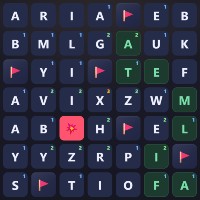
What changes when you choose 4 to 11 letters

The target word length controls a different kind of difficulty. A four-letter word is quick to recognize, but a short pattern can appear in many places. You may see several plausible paths and need to test which one belongs to the round. These rooms are fast and readable, making them a good match for the easy board or for a short timed game.

Five and six-letter targets create a balanced search. They are long enough to feel distinctive but short enough to hold in your head while scanning the grid. Many players will find this range the easiest place to understand the full idea of the game. The minefield still matters, yet the word hunt has enough depth to feel like a real second stage.

Seven and eight-letter targets ask you to plan a route across a wider part of the board. A promising beginning may be separated from the ending you need, so neighboring-cell movement becomes important. Repeated letters can help or mislead you. The best path may turn around a mine, move diagonally, and return through a space you opened much earlier.

Nine, ten, and eleven-letter targets are for players who enjoy searching for structure. The longer word is usually easier to identify once several letters line up, but finding a complete connected route can take time. These lengths work especially well on medium and hard boards because the larger grid gives the word enough room to bend without becoming impossible.

Longer does not always mean harder in a straight line. A distinctive ten-letter pattern may be easier to recognize than a common four-letter word. The challenge comes from the combination of board size, mine density, available lives, and the routes created by the revealed cells. That is why the page lets you choose word length separately from difficulty.

For a first round, try four or five letters on easy. For the most balanced version, try six or seven letters on medium. For a long puzzle session, choose eight or more letters on hard. These are suggestions rather than rules. The best setup is the one that gives you enough time to think without making the board feel empty.

Timed play and free play serve different moods

Timed mode gives the round a clear arc. First you manage the minefield. Then, once the target condition is reached, the game starts a three-minute word hunt. The countdown changes how you read the letters. You cannot inspect every possible path forever, so early observations from the mine stage become valuable. A player who noticed word fragments while clearing mines enters the second stage with an advantage.

Free mode removes that word countdown. It is useful when you want to learn the controls, study how number clues work, or test longer words without pressure. You can pause, compare routes, and understand why a selection failed. Because free mode has no rewards, it stays focused on practice and relaxed play.

The two modes are not a beginner and expert split. An experienced player may choose free mode to experiment with an eleven-letter target. A new player may enjoy the energy of a timed four-letter board. The choice is about pace. Timed play feels like a challenge with a finish line. Free play feels like a puzzle you can sit with.

Signed-in players can carry their Wordichi progress into timed games, spend coins on available skills, and earn the configured rewards for a successful round. Guests can still enter the game immediately and try the full board mechanics. The entry popup lets a new visitor decide whether to continue as a guest or sign in before the selected game opens.

On desktop, the board rewards precise mouse movement and quick visual comparison. On mobile, the layout keeps the grid, lives, mine count, and found-word progress close together. The game is built to remain readable without forcing the player to zoom or scroll back and forth between the puzzle and its status.

Word Minesweeper FAQ

Common questions about the board, words, modes, and guest play.

What is Word Minesweeper? It is an online puzzle that combines Minesweeper clues with a connected-letter word hunt. Safe cells reveal letters, mines cost lives, and the cleared board becomes the place where you find the target words.
Is it the same as classic Minesweeper? The mine logic is familiar, but the round does not stop when the safe area is understood. Revealed letters create a second objective, so your opening decisions also shape the word puzzle.
Can I play Word Minesweeper for free? Yes. Free mode has no word timer and is designed for practice or relaxed play. It does not give gameplay rewards. Timed mode keeps the full challenge and reward setup.
Do I need an account? No. Choose a board and select Continue as guest. You can also sign in before the game opens when you want to use your Wordichi progress and eligible rewards.
How many lives do I get? Each board starts with three lives. A mine hit removes one life, which gives you room to recover from an imperfect decision while still making repeated guessing costly.
How do word paths work? Select neighboring revealed cells in order. The route can turn and move diagonally, but it must remain connected and match one of the hidden target words.
Which difficulty should I choose first? Easy with a four or five-letter target is the clearest introduction. Medium with six or seven letters gives the most balanced experience. Hard is best when you already enjoy both mine deduction and longer word searches.
What happens after I sign in from the play popup? After the PIN is verified, the game you selected opens automatically. When your Wordichi is on another language server, the same board setup opens on that server.

Ready to clear the board?

Choose the version that sounds right today. Start with easy if you want to learn the rhythm, medium if you want both halves of the game to carry equal weight, or hard if you want a larger board that takes time to unfold. Pick a word length, choose timed or free play, and the selected room will open immediately for a signed-in player.

New visitors are not forced through a long setup. The play popup offers two clear choices: continue as a guest or sign in. Either route keeps the board you selected, so you do not have to choose the difficulty and word length again.

Choose a Word Minesweeper board